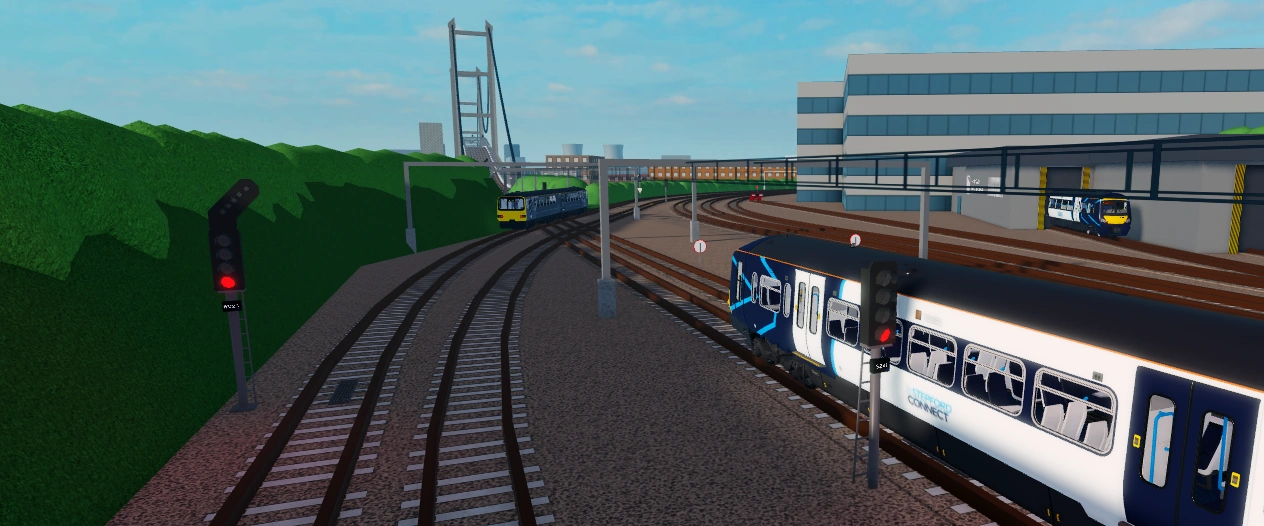

Example of a SPAD near Port Benton due to a conflicting move
A SPAD, abbreviated from signal passed at danger, is an event where a train passes a red signal and thus proceeds past its authorised movement. In certain circumstances, this action is also sometimes called a SPAR (signal passed at red) or an overshoot. While against the rules of Stepford County Railway and thus highly discouraged, it is easy to unintentionally pass signals at danger, for example when being distracted or approaching at an excessive speed. They may also be caused by drivers attempting to cross over another train's path.
Types
Overshoots
Trains are considered to have overshot a station if they have passed the marker they were supposed to stop at or if they have passed the signal at the end of the platform. In some cases, trains may intentionally overshoot beyond the signal in order to get priority, as trains which passed their signal at red must be dispatched first regardless of priorities to clear the signal.
SPARs
A signal passed at red, abbreviated SPAR, occurs when a signal changes to red directly in front of a train, meaning it is impossible to stop before the signal. Most frequently, SPARs occur when a train cuts off another train at a junction or when caused by a signaller, either due to a mistake on the signaller's end or a sudden change in signal during signalling desk setup. A technical SPAR is when a glitch causes a SPAR to occur. Signallers intentionally causing SPARs rarely occurs outside of private servers.
SPAD alarm
Prevention
To avoid SPADs, drivers should follow speed limits and approach red signals slowly. Trains should pass signals set to caution (single yellow) at a maximum of 45 mph in order to ensure they are able to stop before the next signal. In high-risk areas, such as the Beechley Triangle, signals are permanently set to caution so that drivers are alerted to approach slowly. The GUI also displays the state of the next signal, and the Automatic Warning System provides an audible warning as well.
Penalties
If a train passes a red signal, the train's emergency brakes immediately activate, the train is stopped and a SPAD alarm goes off. Once activated, a cooldown of ten seconds applies, after which the train can proceed if the next train block is vacant. Prior to Version 2.0, trains would be despawned if they committed too many SPADs, not allowing the driver to complete their route and obtain experience.
If a SPAD incident occurs at a terminus with no buffers (such as Port Benton), drivers will be unable to continue or switch routes, and they will be forced to return to the menu.
If a SPAD incident occurs during a Qualified Driver training, the trainee will automatically fail.
Passing signals at danger for the sake of causing disruptions may lead to action being taken against the driver by Signallers and Supervisors. Players could potentially be kicked, or even receive operations related penalties.
Bugs
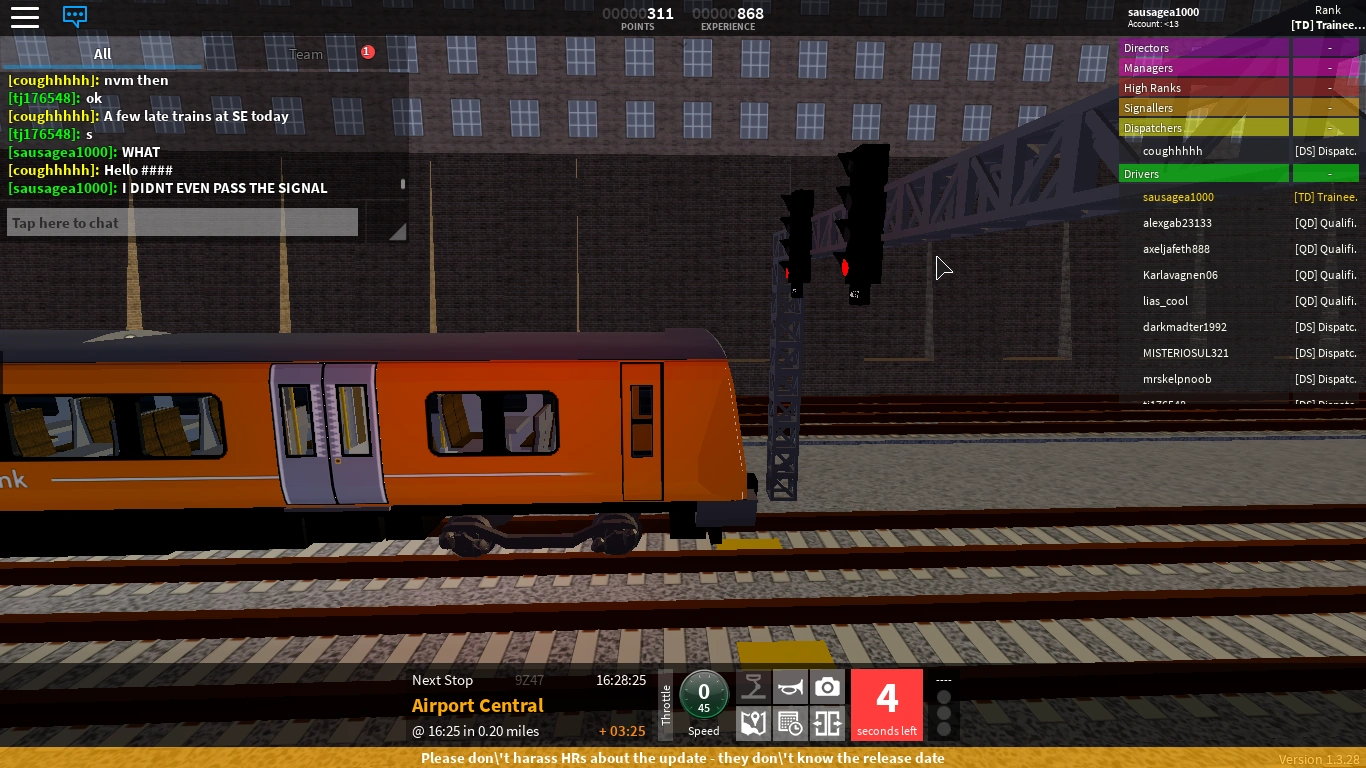

A train that has falsely SPAD, even though it is behind the signal.
- Sometimes SPADs occur even though a train's front wheels have not touched the treadle and the front of the train is multiple studs behind the signal.
- Sometimes, if two trains SPAD at the same time whilst leaving the same station in the same direction, the signaller is unable to change any of the signals so the SPADed trains cannot leave, forcing the signaller to either respawn one of the drivers or leave the desk.
- SPADs can also occur when a laggy driver passes a green or yellow signal, and then being stopped by the emergency brake when the signal automatically turns red after the train touches the treadle, if the game fails to recognise it was the same train.
- Sometimes, the emergency brakes may be delayed if the driver is lagging while committing a SPAD. The driver can cause a crash if the internet connection is turned off seconds before spading and turned on again before the player gets kicked.
- This is the precursor to a glitch where, if the driver then reaches a junction indicator signal activated by another train, they will take the path that the train would have gone to.